
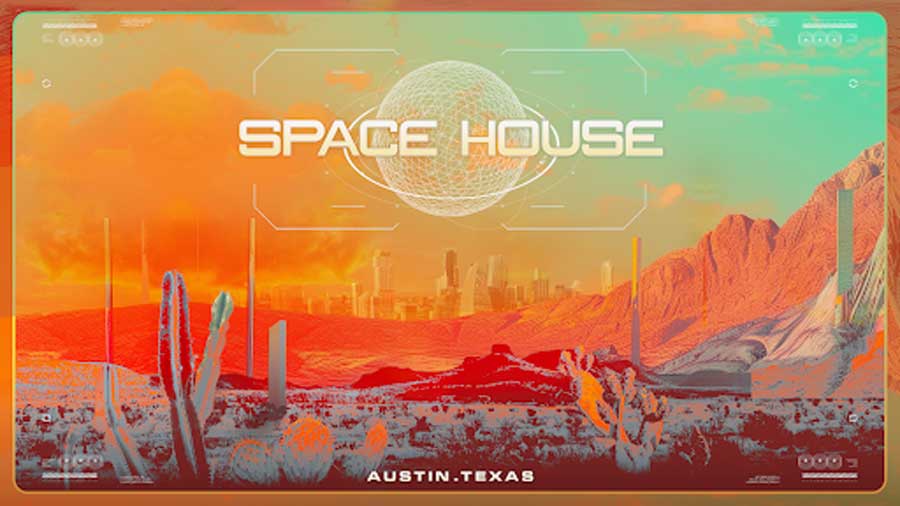
Space House is the result of an incredible community of operators, engineers, founders, technologists, and more. Mission supporters include Firefly Aerospace, IMXP, and the Space Workforce Incubator for Texas (SWIFT), along with generous support from Starbase Brewing, Fibonacci Flight, Still Austin Whiskey, Dulce Vida Tequila, Empress 0.0, ATX Cold Brew and BoothEasy Photo & Video Experiences, with more to be announced soon.
Space House @ SXSW 2026, presented by CesiumAstro
“Texas has become a major force in the commercial space economy,” said Peter Lewis, Chief Commercial Officer of SXSW. “We’re excited to welcome Space House to SXSW as it highlights how space innovation is increasingly central to business, culture, and technology.”
“SXSW has evolved into a global stage where the world’s boldest innovators converge to define what’s next. As a global connectivity leader proudly headquartered in Austin, we see Space House as more than an event – it’s an investment in the future,” said Shey Sabripour, Founder & CEO of CesiumAstro. “Space House will demonstrate how advanced connectivity is powering mission-critical capabilities on Earth and in orbit today, while helping build a lasting legacy of innovation that strengthens and connects our world for generations to come.”
“For us, Space House is about making space feel human,” said Heather Wagner Reed, Founder & CEO of Juice Consulting. “We’re honored to produce this experience for SXSW – where bold ideas meet real people – and to open the door to conversations about how space innovation touches everyday life on Earth. This is a place where the companies shaping space can connect directly with the culture, creativity, and curiosity that define this festival.”
A Vision for Tomorrow, Landing in Austin
At the intersection of technology, culture, and imagination, Space House transforms the idea of space from a distant concept into something tangible, accessible, and urgently relevant. From satellites that power daily life to the emerging lunar economy, Space House will be where tomorrow’s space economy meets today’s creative and cultural conversations. Designed as an immersive sanctuary for pioneers, builders, and believers – those asking not only what’s next for space, but why it matters here on Earth. Through panels, conversations, and curated experiences, attendees will explore how commercial spaceflight, orbital infrastructure, AI, and interplanetary ambitions are reshaping economies, industries, and everyday life. Guests of the house will:
- Discover how space technology quietly powers everyday life, and why it’s the ultimate frontier for collective progress
- Connect with industry leaders, founders, and explorers redefining what’s possible beyond Earth
- Experience the cultural and human side of space, where innovation meets storytelling, creativity, and community
- Hear from the companies and thought leaders literally blazing the trail, bridging the gap between orbital innovation and terrestrial impact
Where Humanity Meets the Infinite
The house will offer fireside chats, roundtables, talks, networking opportunities, a space speed dating event, and evening mixers featuring music by the likes of Robot Sunrise, libations and more to be announced soon.
Featured topics will include:
You’re Already Living in the Space Age
Space isn’t distant anymore – it’s already woven into daily life. From navigation and communications to weather, agriculture, and disaster response, systems in orbit quietly shape how we live, move, and stay safe. This talk will frame space not as a frontier, but as something deeply human and connected to life on Earth, a reality most people rely on every day without realizing it. It’s a conversation about proximity, dependence, and belonging: how the boundary between Earth and orbit is dissolving, and why space now feels less like somewhere we go and more like something we’re part of.
The Cosmos Has Entered the Chat
Rocket launches go viral. Satellite imagery shapes global headlines. Astronauts build audiences. Infrastructure most people never see is now influencing what the world watches, shares, and reacts to in real time. This session explores how orbit moved from background technology to cultural signal and what happens when space becomes part of the attention economy.
When Satellites Make Decisions
Satellites are beginning to make operational decisions on their own, routing data, prioritizing users, avoiding interference, and managing resources without waiting for instructions from the ground. This session explores what autonomy in orbit actually looks like today, not in theory, not in sci-fi, but in real systems already flying or in development. We’ll dig into what decisions satellites can safely make onboard, where humans still have to stay in the loop, how autonomy changes mission design, risk, and accountability, the role of onboard processing, signal intelligence, and network orchestration and how different missions are converging around autonomous operations. The conversation won’t be about “AI hype.” It will be about trust, constraints, and the engineering reality of letting machines operate infrastructure in space. This is a session about the next shift in space operations: from human-controlled assets to self-managing systems.
The Space Cowboy: A New Industrial Workforce – presented by SWIFT
The future of space won’t be limited by technology, it will be limited by people. As commercial space scales, the biggest constraint is workforce: technicians, engineers, operators, manufacturing talent, and the systems that train and place them. This session brings together leaders shaping the space workforce at scale – across industry, workforce development, education, and state strategy – to explore what it takes to build and sustain the talent behind modern space operations in Texas and beyond.
Hard Lessons from the Moon: Low Gravity, High Stakes
Space doesn’t offer practice runs. You build for years, simulate everything you can, and then the spacecraft makes the final decisions on its own, far beyond human reach. When a landing doesn’t go as planned, the outcome still has benefits. It’s data. It’s clarity. It’s the kind of learning that only happens in real conditions, not in labs or simulations. This talk explores why imperfect landings are part of progress, and how each attempt brings us closer to operating reliably on the Moon and beyond.
How Space Is Reshaping Capital
As the industry matures, capital is shifting away from novelty and toward infrastructure, execution, and real customers. This session looks at how investment decisions in space are actually made today: what signals matter, what investors avoid, and why some parts of the industry attract capital while others struggle. In this talk we will explore how funding priorities have changed since the early “new space” wave, where investors see real durability vs hype, what technical credibility actually looks like to capital, why manufacturing, workforce, and infrastructure are becoming investable and what separates companies that raise from those that survive. This is a conversation about judgment, risk, and what it really takes to build a fundable space business.
From Outpost to Home: The Next Era of Living in Space
Humans have lived in space for decades, but mostly in one government-led outpost built for science. What’s coming next is different: more destinations, more operators, more people, and longer stays. And what about living in free space, on the moon, or Mars? What is THAT going to be like? The challenge shifts from “can humans survive?” to “how do we build places humans can actually live? This session explores the next era of habitation: how habitats are designed, how life-support and autonomy evolve, what we’ve learned from the ISS, and what changes when living in space becomes routine rather than rare.
Space Is Bigger in Texas
Does a ten gallon hat symbolize more opportunity? We think so. Texas has quietly become one of the most important places on Earth for space. From Houston’s mission control roots to Starbase on the Gulf Coast, the state now hosts launch sites, massive manufacturing facilities, fast-growing startups, and a deep pool of talent shaping the future of spaceflight. This panel explores how Texas went from “space adjacent” to a full-blown space powerhouse, and why so much of the industry is choosing to build here. We’ll dig into what’s driving the Texas space boom: policy choices, talent migration, private capital, and the rise of commercial launch and lunar infrastructure. What makes Texas uniquely attractive to space companies? What tradeoffs come with that growth? And how does Texas fit into the global competition for space leadership? Whether you’re a founder, investor, engineer, or just space-curious, this conversation will unpack why space really is bigger in Texas, and what that means for the next decade of the space economy.
Why Artemis Changes Everything
We’re heading back to the moon, y’all, but not like last time. Artemis isn’t about planting a flag and heading home. It’s about staying, building, and turning the Moon into the next proving ground for deep space exploration. This panel unpacks what Artemis really represents: a shift from heroic one-offs to sustained, commercial, multinational presence in space. This talk will dive into the messy, fascinating reality behind the program: the tech bets, the timelines, the private companies shaping the mission stack, and the geopolitical stakes of returning to the lunar surface. What does it actually take to build infrastructure off Earth? Who benefits from a Moon economy, and who gets left out? If you’re into space, startups, policy, or the future of civilization, this is your chance to zoom out and understand why Artemis isn’t just about the Moon – it’s about what comes next for humanity in space.